
Starship’s upper stage shows the marks of a tough battle on its 10th test flight. Its stainless steel exterior, once gleaming, now bears scars, orange streaks, charred patches, and bare metal, testifying to its survival through the extreme heat of reentry.
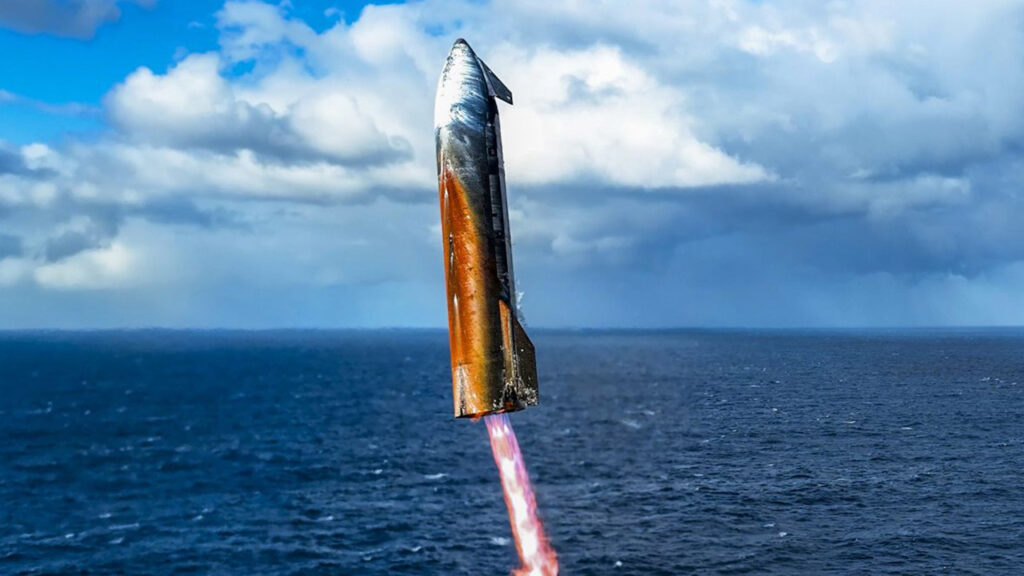
Starting with the heat shield, thousands of silica tiles once protected the spacecraft from intense heat. On Flight 10, SpaceX experimented with metal tiles and intentionally left gaps to test durability. The result was a mosaic of damage: orange streaks across the tiles, which Elon Musk explained come from rusted test tiles, while white patches indicate insulation replacing lost tiles. These marks serve as vital data points, proving the shield endured intense stress.
The stainless steel body, chosen for durability over lighter materials like carbon composites, shows a mix of shiny and dented areas. Scorch marks and heat patterns ripple across the hull, revealing the extreme friction and temperatures encountered during the descent into the Indian Ocean. Unlike earlier, pristine prototypes, this Starship wears its battle scars proudly, a chaotic blend of burnt oranges, deep reds, and ashen grays.
The flaps, crucial control surfaces for the belly-flop maneuver during reentry, faced the brunt of the flight. Images show them burned, with some areas glowing red-hot during descent. SpaceX applied an ablative coating, likely pyron, which burned away in patches, leaving exposed steel and charred remnants. Despite their battered state, the flaps performed flawlessly, guiding the spacecraft to a controlled splashdown, illustrating the extreme conditions they survived.
The payload bay, a new addition, performed successfully on this flight. Starship deployed eight dummy Starlink satellites for the first time. The bay door, a “Pez dispenser” mechanism, opened in space and released its cargo perfectly. Post-flight photos show singed edges and burn lines around the door, but its intact operation proves the spacecraft is ready for real-world missions, such as expanding the Starlink constellation.
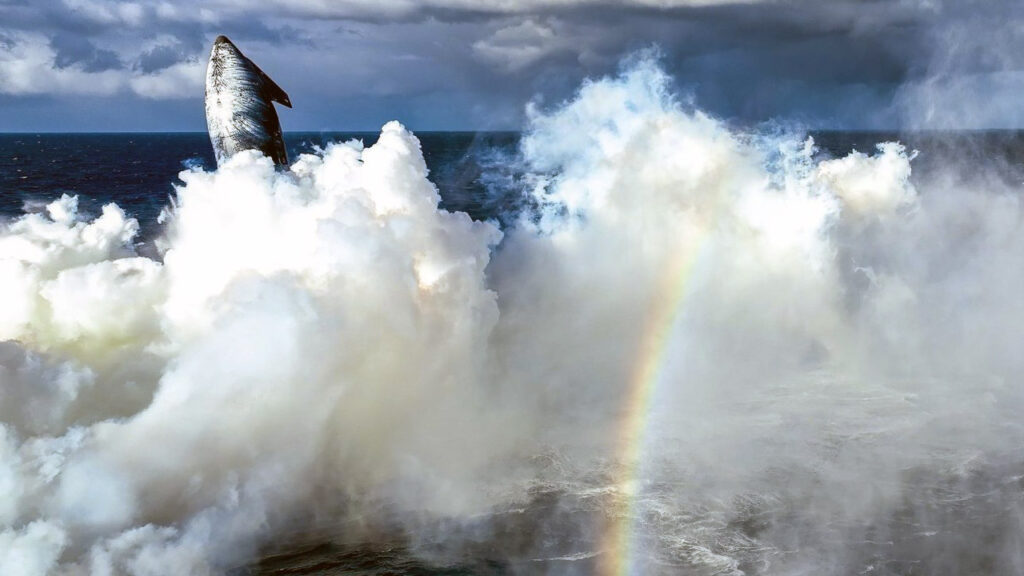
Flight images also show the six Raptor engines firing in space, while post-landing photos reveal soot-darkened nozzles and heat-stressed metal from the relight test and landing burn. These Raptor 2 engines, more efficient than their predecessors, enabled Starship to reach suborbital heights and return safely. The surface wear, discolored steel and faint erosion, testifies to the immense power and punishment endured.
NASA’s Artemis mission, aiming to land humans on the Moon by 2027, relies on a variant of this spacecraft. Starship’s ability to survive reentry, deploy payloads, and land upright, as demonstrated in the Indian Ocean, brings that lunar goal closer to reality.