
NGC 7456, a spiral galaxy located 51 million light-years away in the constellation Grus, may appear as a simple cluster of stars at first glance. However, Hubble Space Telescope’s Wide Field Camera 3 reveals its warm glow, irregular spiral arms, and vibrant pink regions where new stars are forming.
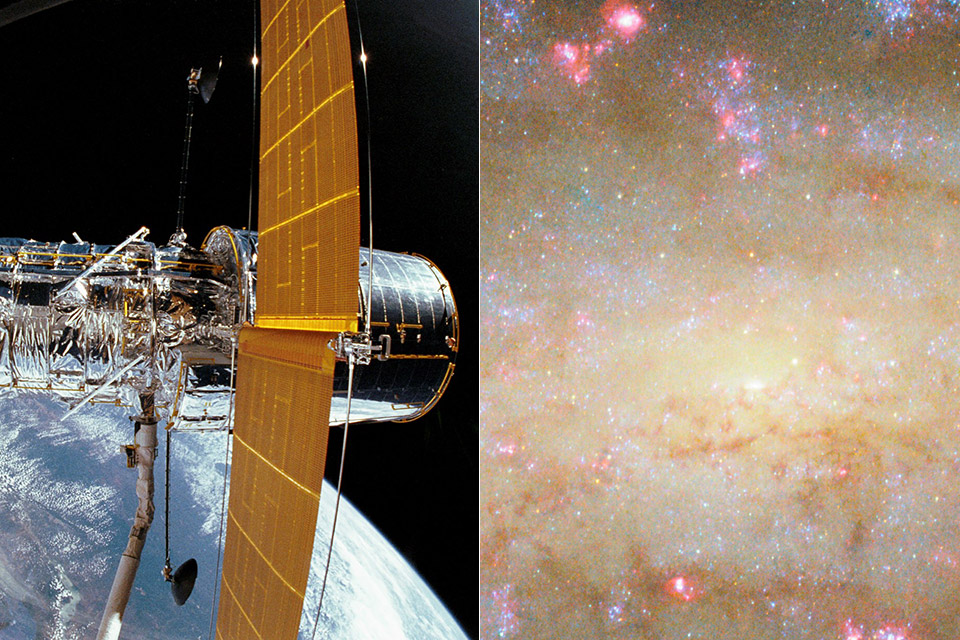
Spiral galaxies are recognizable for their pinwheel shapes and star-filled discs. NGC 7456 follows this familiar pattern while introducing unique features. Its spiral arms are uneven, interwoven with dark dust lanes that obscure some of the light. These warm arms extend from a luminous core, home to a supermassive black hole powering an active galactic nucleus. This central engine makes NGC 7456 more than visually appealing; it is a dynamic system emitting energy across the galaxy. The image combines ultraviolet, optical, and infrared data, highlighting activity from the center all the way to the outer edges.
Bright pink regions scattered along the arms mark star-forming zones, where clouds of gas collapse to create new stars. Seen through Hubble’s H-alpha and NII filters at 657 nanometers, these stellar nurseries glow red. Each of these pockets is a site of intense creation, transforming gas into stars that will shine for billions of years.
Beyond what the eye can see, NGC 7456 hides more mysteries revealed by X-rays. Observations by ESA’s XMM-Newton satellite identified ultraluminous X-ray sources—compact objects that emit unexpectedly high levels of X-rays. These may be black holes or neutron stars consuming surrounding material, though their exact nature remains uncertain. Each source contributes to the galaxy’s reputation for unusual physics. Hubble’s visible light data complements these X-ray findings, offering a fuller understanding of the galaxy’s activity.
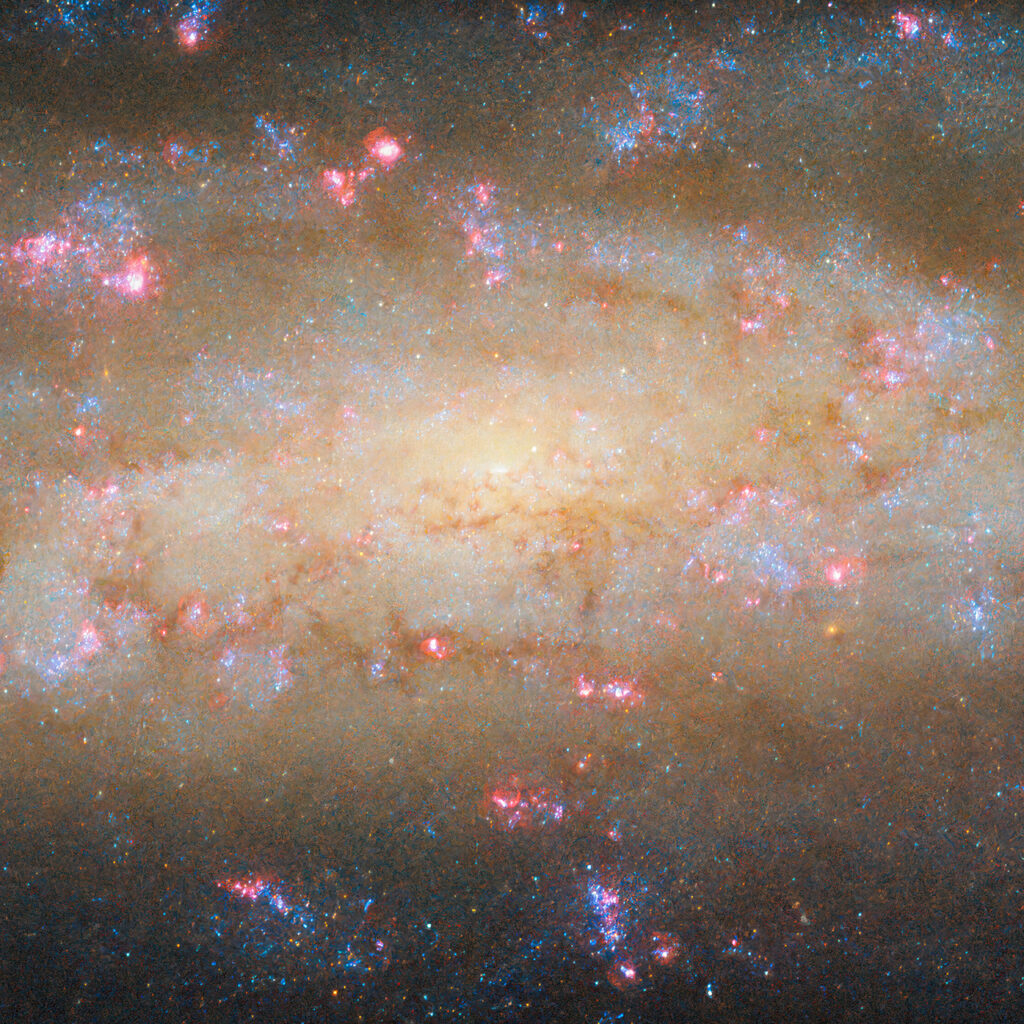
The core, where the supermassive black hole resides, is a particularly energetic region. Active galactic nuclei like this one generate enormous amounts of light and energy as matter is drawn inward. This central area of NGC 7456 shines brightly, distinguishing the galaxy from others, while the Hubble image captures the transition from the glowing center to the softer light of the spiral disc. It serves as a visual anchor for the galaxy’s overall structure.
Hubble’s wide range of filters, from 275 nanometer ultraviolet to 814 nanometer infrared, presents NGC 7456 in multiple perspectives. Ultraviolet highlights hot, young stars; optical bands reveal structural details; and infrared penetrates dust to uncover hidden features.